
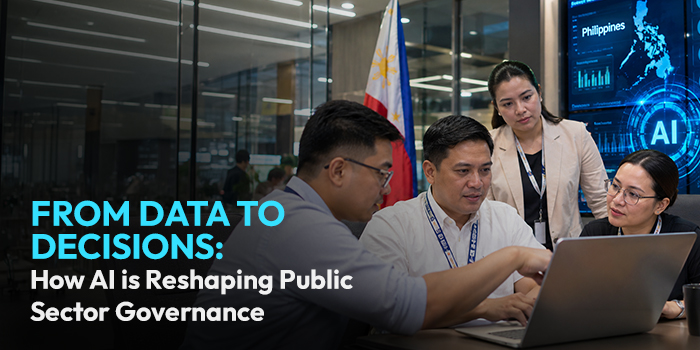
Across the Philippines, public institutions face growing pressure to improve service delivery, transparency and responsiveness to citizens’ needs. The adoption of AI is helping agencies analyse large volumes of data, monitor infrastructure, and strengthen public safety. Government organisations are also developing data-driven systems to give officials better insights and support more informed decision-making.
As discussions around AI maturity, security, and governance gain momentum, public-sector leaders must consider how these technologies can advance national priorities while ensuring accountability, public trust, and regulatory compliance across government agencies and local government units.
Across the country, different government agencies are beginning to move away from basic data collection and instead utilising AI-powered systems to aid decision-making. Under the National AI Strategy Roadmap 2.0 (NAISR 2.0), public institutions in the Philippines are looking at how they can utilize automation and machine learning tools to help them improve policy planning.
Many Local Government Units are beginning to utilise AI-powered solutions to help reduce their administrative workload. By using predictive analytics tools, agencies are able to identify trends, predict risk factors, and place emphasis on what services they should be focusing on providing to the public. This also enables more informed decision making from officials.
Within higher education and government departments, AI has further helped increase productivity within staff members. Tools such as automation, digital documentation, and task management have been implemented. Within urban planning and transport, agencies are using predictive tools to help forecast issues such as congestion, population and infrastructure needs.
Natural Language Processing (NLP) and advanced analytics tools can also help government agencies respond more effectively to challenges in emergency management, public health, and citizen services. However, AI adoption remains uneven across National Government Agencies (NGAs) and Local Government Units (LGUs). Barriers include limited digital infrastructure, inconsistent data quality, and varying levels of technological readiness.
As public institutions begin to modernise their operations, conversations around AI have become a key topic of discussion at all major digital government conferences.
AI applications are already reshaping several public sector functions in the Philippines by improving operational accuracy, response times, and citizen interaction models.
Key applications include:
AI-powered chatbots and virtual assistants are enabling agencies to provide 24/7 responses to citizen queries related to permits, documentation, taxation, and public programs. These systems reduce the workload on front-office personnel while improving service accessibility for residents across urban and regional areas.
Government departments handling permits, licenses, and regulatory approvals are integrating Optical Character Recognition (OCR) and AI-assisted document processing to accelerate administrative workflows. Automated verification systems can reduce manual errors, shorten approval timelines, and improve record management capabilities.
The Philippines remains highly vulnerable to floods, earthquakes, and typhoons, making predictive intelligence a critical public sector priority. AI-based forecasting systems can analyze weather patterns, environmental data, and historical disaster records to support early warning systems and emergency preparedness planning.
AI is increasingly supporting traffic optimization and urban monitoring initiatives. Surveillance systems combined with sensor-based analytics can help agencies monitor congestion, identify violations, and improve road management strategies in densely populated areas.
Machine learning models are also helping agencies interpret large datasets for resource allocation, infrastructure development, and public welfare planning. These capabilities are expected to become a stronger focus area at upcoming government innovation summits, where policymakers and technology leaders discuss scalable governance frameworks and AI implementation strategies.
Having strong data infrastructure and interoperability are vital to successfully implementing large scale AI applications. AI requires access to high quality standardised data to deliver real business outcomes. Current assessments show that the Philippines has a few strong foundations in place to implement AI, however many agencies still have challenges to overcome.
The healthcare sector provides a useful example of the importance of data infrastructure and interoperability. Many Local Government Units (LGUs) operate separate information systems, making it difficult to coordinate healthcare services and share patient information efficiently.
To address this, some LGUs are developing local health information exchanges to improve access to patient records and support better coordination between healthcare providers. Investment in cloud solutions can also help agencies move away from outdated legacy systems, enabling more scalable infrastructure and systems that are better equipped to support future AI applications.
The government has also started treating data as a strategic national resource. They have created secure data sharing between NGAs and LGUs. They have also improved policies around data governance to ensure data privacy, compliance, and quality. Interoperability helps to drive transformation within the public sector by ensuring less duplication, greater coordination and quicker access to key records.
Establishing common data standards, consistent metadata structures, and unified data management practices will be important to advancing future e-government solutions in the Philippines across multiple sectors.
As AI systems play an increasingly important role in public administration, the need for strong governance and accountability becomes increasingly critical. Public concern over how AI systems make automated decisions is also growing, making it essential for government agencies to establish clear oversight mechanisms and ensure responsible use. Algorithms must be transparent, explainable, and open to independent auditing, particularly when used in sensitive areas such as healthcare access, law enforcement, public welfare and regulatory enforcement.
Another major concern is algorithmic bias. Poor-quality datasets and unbalanced models can produce unfair outcomes, potentially placing vulnerable communities at a disadvantage. Involving citizens and relevant stakeholders in AI governance can help identify these risks and promote more inclusive decision-making. Clear regulatory frameworks are also needed to guide AI adoption across government. These should establish safeguards for data privacy, technology procurement, algorithmic oversight and ethical AI use, ensuring that the expansion of AI in public administration remains fair, transparent and accountable.
As public institutions adopt AI-powered systems, cybersecurity risks are expanding alongside operational capabilities. Data-centric governance models significantly increase the exposure of national infrastructure, citizen databases, and interconnected government platforms.
Securing public data ecosystems has therefore become a national priority. AI-enabled governance systems require strong cybersecurity controls, including identity management, threat monitoring, encryption protocols, and incident response frameworks.
AI itself is also being used to strengthen security operations. Intelligent threat detection systems can identify suspicious network activity, automate risk analysis, and improve response coordination across agencies. Predictive cybersecurity tools are helping institutions identify vulnerabilities before they escalate into major incidents.
These discussions are becoming increasingly prominent at every major cybersecurity summit in the Philippines, where government leaders, infrastructure specialists, and technology providers are assessing strategies to protect public systems against emerging threats.
Public trust in AI-driven governance will ultimately depend on whether agencies can maintain secure, compliant, and transparent digital ecosystems capable of protecting sensitive citizen information.
Adopting AI across the public sector requires significant investment in digital infrastructure, cybersecurity, system modernisation, and workforce development. Budget constraints and limited technical expertise can make it difficult for government agencies to implement and scale AI solutions independently. Public-private partnerships (PPPs) can help address these challenges by providing access to private-sector expertise, technology, and financial resources.
Technology providers, cloud service companies, cybersecurity firms and systems integrators are increasingly important partners in supporting government AI initiatives. Through collaboration, public institutions can access the capabilities needed to develop, deploy and maintain AI-powered systems while building long-term technical capacity.
Key areas where public-private collaboration can support AI adoption include:
Looking ahead, government agencies must strengthen digital infrastructure, improve data interoperability, develop workforce capabilities and establish robust governance frameworks to ensure AI is deployed responsibly. Close collaboration between the public and private sectors is therefore essential to overcome implementation challenges.
GOVNEXT Philippines 2027, taking place on 16 March 2027 at the Manila Marriott, Philippines, will bring together government officials, policymakers, enterprise executives, sponsors, and technology innovators to explore these priorities.
Attendees will have the opportunity to discuss practical AI applications, examine investment and PPP opportunities, exchange implementation insights, and build partnerships that support public-sector modernisation.
For more information, visit: https://www.philippines.govnextsummit.com/

All rights reserved. © 2026 Tradepass LLP.