
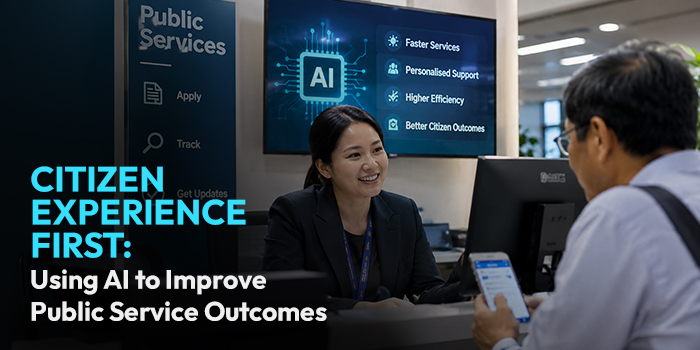
As expectations of government services evolve, citizens increasingly demand the same convenience, speed, and accessibility they experience in other aspects of their lives. Artificial intelligence is emerging as a valuable tool for helping government agencies streamline administrative processes, improve efficiency, and deliver more responsive, citizen-centred services.
Across the Philippines, agencies are exploring how AI can support digital government transformation by simplifying service delivery, improving access to information, and ensuring public services are easier to navigate.
This blog explores how the Philippines is using digital transformation and AI to improve citizen experience, address long-standing governance challenges, and make public services more efficient and transparent.
Improving citizen experience has become an important priority for the Philippine government as it works to reduce bureaucratic red tape, address corruption, and strengthen public trust.
The shift from traditional paper-based processes towards more citizen-centred digital services is central to these efforts.
Four key areas are explored below:
Eradicating Bureaucratic Friction
Long waiting times, repetition of documents, and complicated procedures have led to frustration for customers. Removing this complexity will therefore increase efficiency and, by that extension, improve overall citizen satisfaction.
Tackling Institutional Corruption
Complicated processes can cause a lack of transparency, creating opportunities for unofficial third parties. Digital processes and customer-centric services that streamline transactions and reduce unnecessary intermediaries enhance accountability.
Leveraging Digital Transformation
The government continues to expand digital portals and integrated service platforms, making public services easier to access, improving citizen engagement and simplifying interactions with government agencies.
Rebuilding Public Trust
Timely, reliable, and transparent service delivery is essential to strengthening public trust. Consistent and effective digital services are particularly important during emergencies and the implementation of public programmes.
AI is transforming public services in the Philippines by reducing administrative bottlenecks, improving response times, and expanding access to government programs. AI-driven platforms are helping agencies deliver services that are more responsive to citizen needs.
eGovPH Superapp
The Department of Information and Communications Technology (DICT) continues to enhance the eGovPH platform by integrating intelligent workflows that connect multiple government services through a unified digital experience.
National ID Integration
AI-assisted verification supports secure identity authentication, helping citizens access services more efficiently through the Philippine Digital National ID ecosystem.
Healthcare Diagnostics
Telemedicine services supported by AI are extending healthcare access to remote communities, enabling faster assessments and supporting medical professionals in underserved areas.
Increased Speed
Automation and predictive analytics reduce processing times for permits, clearances, registrations, and social service programs.
Enhanced Accuracy
Machine learning and natural language processing help minimize human errors in records management, tax administration, and document verification.
Accessibility
AI-powered chatbots and virtual assistants provide support round-the-clock, helping citizens navigate services in multiple local languages and dialects.
Momentum behind public sector digital transformation in the Philippines continues to build as government agencies modernise operations, adopt new technologies, and improve public service delivery.
National programs supporting digital governance reforms are creating stronger foundations for integrated public services. Government agencies are increasingly adopting tech solutions that improve data sharing, service coordination, and operational efficiency.
Efforts to strengthen interdepartmental collaboration are helping break down institutional silos and create a more integrated government ecosystem. Meanwhile, investments in digital infrastructure are expanding access to online services, particularly in remote and underserved communities.
Together, these developments support a more citizen-centred approach to governance, placing public needs at the heart of policy development, service delivery, and government engagement.
The Philippines is pushing hard on initiatives that redirect the private sector towards a digital future with responsible use of AI, cloud computing, and semiconductors. The Department of Information and Communications Technology (DICT) leads these public-private partnerships to implement e-governance, digital literacy, and economic competitiveness.
Key pillars of this collaboration include:
As adoption of AI in public services grows exponentially, governments will need to ensure that technology investments translate into meaningful improvements in citizen experience. This will require more than just deploying new tools. Reliable digital infrastructure, effective governance frameworks, and long-term planning will be essential to support responsible AI adoption.
Future government technology solutions must also be scalable and supported by data-driven decision-making. By using data to monitor performance and identify areas for improvement, government agencies can make more informed decisions and deliver more responsive services.
Together, these priorities will inevitably shape the next phase of digital government transformation and public-sector modernisation in the Philippines.
The future of digital government will depend on how effectively the Philippines brings together technology, infrastructure, policy, and public-private collaboration to improve the delivery of public services. From responsible AI adoption and stronger digital infrastructure to workforce development and data-driven governance, each element will play a crucial role in building a more connected and inclusive public sector.
Taking place on 16 March 2027 at the Manila Marriott, Philippines, GOVNEXT Philippines 2027 will bring together government decision-makers, policymakers, industry stakeholders, and technology leaders to address these priorities.
Attendees will have the opportunity to examine AI applications in public service delivery, understand the infrastructure and interoperability requirements for connected government systems, explore financing and PPP models for large-scale digital projects, and discuss approaches to cybersecurity, data governance and workforce development.
The event will also provide a platform to connect with potential technology and investment partners, exchange implementation insights and identify opportunities for collaboration on the Philippines’ digital government priorities.
For more information, visit: https://www.philippines.govnextsummit.com/
1. Why is citizen experience a key topic for government leaders in the Philippines?
Improving citizen experience can strengthen public trust, increase operational efficiency and support more effective policymaking. By placing citizens’ needs at the centre of service design, government agencies can deliver services that are more accessible and easier to use.
2. How can AI make services better, whilst ensuring accountability?
AI can improve public service delivery by automating routine processes, reducing errors, and accelerating response times. Strong governance frameworks, human oversight and transparent practices are essential to ensuring accountability.
3. How can public-private partnerships assist governments with their digital transformation?
Public-private partnerships offer governments technological, financial, and operational resources to speed up innovation and improve services.
4. What should be considered when implementing AI across Government?
Key priorities should include data protection, workforce readiness, system interoperability, responsible AI adoption, and effective performance measurement metrics.
5. Why is an event like this important?
Events such as GOVNEXT bring government leaders, technology providers, policymakers and investors together to exchange knowledge, explore shared priorities, and build strategic partnerships that advance digital transformation.

All rights reserved. © 2026 Tradepass LLP.