
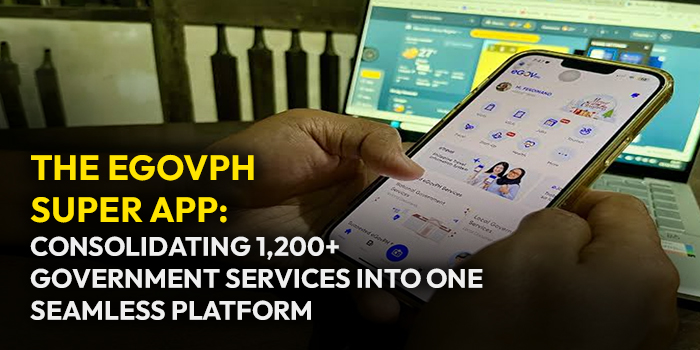
A citizen applying for a clearance, paying a government fee, accessing a digital ID or requesting a local document should not have to understand how government agencies are organised before receiving a service. Yet fragmented portals and inconsistent credentials have historically made public transactions difficult. The eGovPH Super App is changing this model by bringing national and local services into one mobile gateway.
With around 40 million users reported this year, and additional services being integrated, the platform is becoming a major component of the Philippines’ public-service infrastructure.
Fragmented services create unnecessary costs for both citizens and government. A person may have to enter the same personal information repeatedly, maintain different accounts and visit multiple agency websites for one transaction.
For businesses, these delays can also affect permits, registrations, and compliance activities.
The eGovPH model addresses these challenges through a centralized access point, unified digital credentials, application tracking, and seamless connections between national and local government services. The government has positioned the platform as a means of reducing lines, fixers, and bureaucratic red tape.
Developed by the Department of Information and Communications Technology (DICT), the platform brings together government transactions, digital IDs, and agency services through one application. Its growing adoption reflects a wider shift towards digital government services designed around citizen needs. As of 2026, the app had surpassed 10 million downloads on Google Play alone.
The strategic value extends beyond convenience. Reducing the need for face-to-face transactions can limit opportunities for fixers, while shared digital infrastructure can help minimize duplication across agencies. The eGov Data Exchange (eGovDX) is central to this approach, providing a platform designed to connect government systems and enable interoperability. Current eGovDX information cites integration support for 75 national government agency (NGA) systems and 927 local government unit (LGU) systems.
A super app is only as effective as the infrastructure supporting it. Behind eGovPH, the eGov Data Exchange (eGovDX) provides a technical bridge between government systems, enabling data exchange through APIs and common services rather than forcing citizens to move between disconnected applications.
The scale is already significant. The Presidential Communications Office reported more than 130 million eGovPH transactions and over 12 million users in 2025. Furthermore, by March 2026, DICT reported approximately 40 million users, demonstrating how quickly demand can increase as additional services are introduced.
The real test of e-government solutions in the Philippines is not the number of services listed in an application, but how many transactions can be completed without unnecessary physical steps.
Recent integrations show how eGovPH is expanding beyond basic information access towards transactional government services. In July 2026, the National Bureau of Investigation (NBI) and the Department of Information and Communications Technology (DICT) launched the NBI eClearance through eGovPH, enabling eligible users to renew their clearance in less than five minutes.
Earlier, in April 2026, the Bureau of Internal Revenue (BIR) made its Digital TIN ID available through the app as well.
The next challenge is scale. Adding more e-Government services requires reliable identity management, cybersecurity, privacy controls, API standards, cloud capacity, and digital skills across agencies and LGUs. The April 2026 disruption of the eGovPH Super App shows the infrastructure pressures that can accompany rapid adoption. A surge in simultaneous user activity overwhelmed the platform’s servers, prompting the Department of Information and Communications Technology (DICT) to upgrade and expand system capacity.
This makes digital governance platforms an institutional priority, rather than simply an application-development exercise. The broader Bagong Pilipinas digital transformation agenda will depend on interoperable systems, common standards, robust data governance, and sustained coordination among national government agencies, LGUs, and technology partners. Its success will ultimately depend not only on the availability of digital services, but also on the institutional capacity to integrate, govern, secure, and scale them effectively.
GOVNEXT Philippines 2027, taking place on 16 March 2027 at the Manila Marriott, will bring together senior government officials, policymakers, C-suite leaders, technology experts, and industry partners to examine the challenges and opportunities of building the next generation of citizen-centric public digital services.
The agenda will look at urgent issues that matter most as the Philippines expands its e-Government ecosystem through interoperability between agencies and LGUs, digital identity, cybersecurity and data protection, infrastructure capacity, standards, and the implementation of shared digital platforms.
Join the discussion to hear directly from leading government and technology pioneers, and identify where policy, infrastructure, governance, and technology need to work together to make digital public services more reliable and easier to access.
1. What is the eGovPH Super App?
The eGovPH Super App is a DICT-developed platform that unifies all government services onto a single application.
2. How many government services does eGovPH provide?
The platform is designed to consolidate more than 1,300 government services, with its service portfolio continuing to expand as additional national agencies and LGUs are integrated.
3. What is the role of eGovDX?
eGovDX provides the interoperability layer connecting government systems and platforms, supporting secure data exchange and integration between national agencies and LGUs.
4. Why is interoperability important for Philippine e-Governance?
Interoperability allows agencies to exchange relevant information efficiently, reducing duplicate data requests, repeated processes and fragmented citizen experiences across government transactions.
5. How can leaders participate in GOVNEXT Philippines 2027?
Government leaders, policy makers, technology providers, sponsors and senior industry professionals can participate to discuss governance priorities, technology solutions, partnerships and citizen-centric public-service delivery.

All rights reserved. © 2026 Tradepass LLP.